
Let’s take a quick look at the anatomy of a CNC machine and we’ll go into more detail later.
Almost all 3 axis CNC machines operate using the same basic concept. They have a cutting head, often a spindle, which is moved along 3 axes, X, Y and Z.
When picturing a CNC machine, it is often similar to the one pictured below. These are called Cartesian machines. The Cartesian coordinate system was first published in the 17th century by French philosopher and mathematician René Descartes. It is a system used to describe the exact position of an object using 3 numbers eg. 5,5,5 that refer to positions along 3 axes that intersect each other at 90 degrees.
If looking front on at the machine, the X axis is left to right, the Y axis is front to back and the Z axis is up and down. The spindle is mounted on the Z axis.
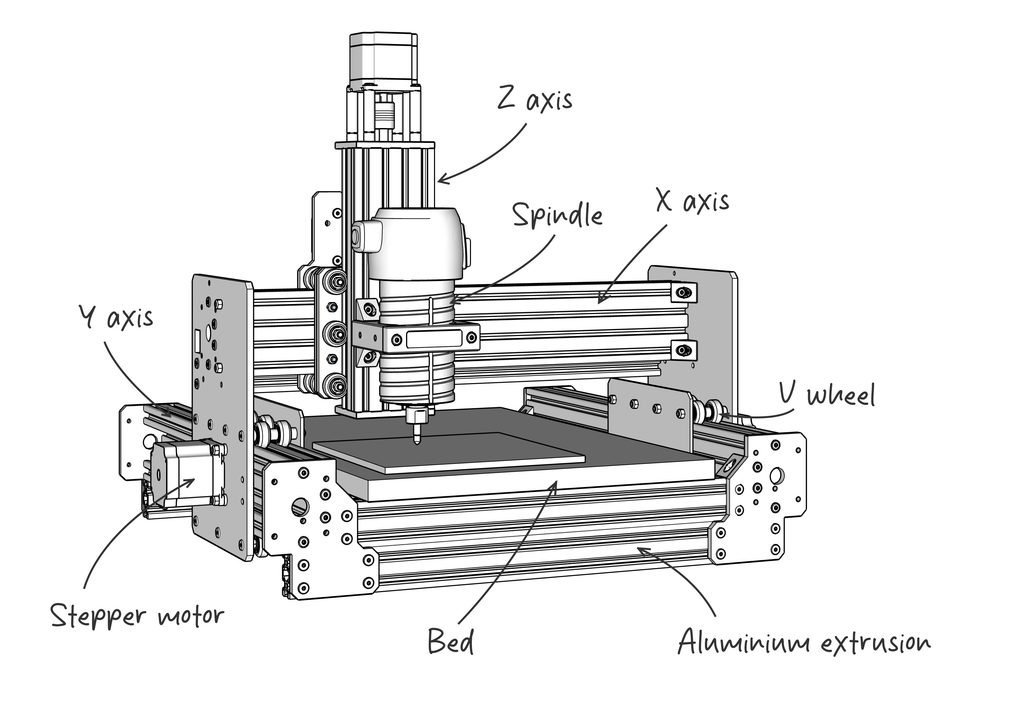
Movement along the axes is produced by either a screw or a belt drive. The motion is produced using either stepper of servo motors. Stepper motors are commonly used on desktop CNC machines due to their low cost. Servo motors are more common on industrial machines. Servo motors have a closed feedback loop.
There are 2 types of spindles commonly used on desktop CNC machines. The first is a router spindle. These are literally the motor from an electric hand router which is normally used for woodworking. The other common type is a VFD spindle.
End stops are placed at the ends of the axes travel. They can be used to set the datum of the machine. They can also be useful if the stepper motor misses steps and the actual position of the axis is different to that reported on the controller.
In modern machines, linear rails are becoming more popular as their price decreases. Polished rods and linear bearings are also popular. V wheels running on aluminium extrusions have also been popular in the past. The machine that I use to illustrate this series uses V wheels.
The bed on a desktop CNC machine is where the material to be machined is held. There are many options for the bed material itself and for how the material to be machined is held onto the bed. One of the first things to be done on a CNC machine is to tram the bed. Tramming the bed involves machining the surface to make sure it’s perpendicular to the spindle and the axes.
As you might imagine, there are many controller options for a desktop CNC machine. One of the most simple and cheapest options is a GRBL CNC shield. It’s a simple board that sits on top of an arduino uno and houses the stepper drivers needed to run the motors.
More modern controllers use 32-bit processors such as the ESP32 to replace older 8-bit boards like the Arduino Uno.
The frame of the CNC machine can be fabricated from a variety of materials. Industrial machines can be made from cast iron and epoxy granite bed for the utmost rigidity and vibration dampening properties. At the other end of the scale, there are popular desktop CNC machines made from 3d FDM printed parts. What’s important is that the machine is capable of it’s intended use. For example, a lightweight frame is perfectly capable of machining foam accurately.
In recent years, aluminium extrusions have been popular for making CNC frames. These machines can be relatively affordable and simple to modify. The trade off can be lack of rigidity required to machine more demanding materials such as ferrous metals.
This is a brief overview of the anatomy of a CNC machine. Next we’ll break the machine down into each component and go into more detail.